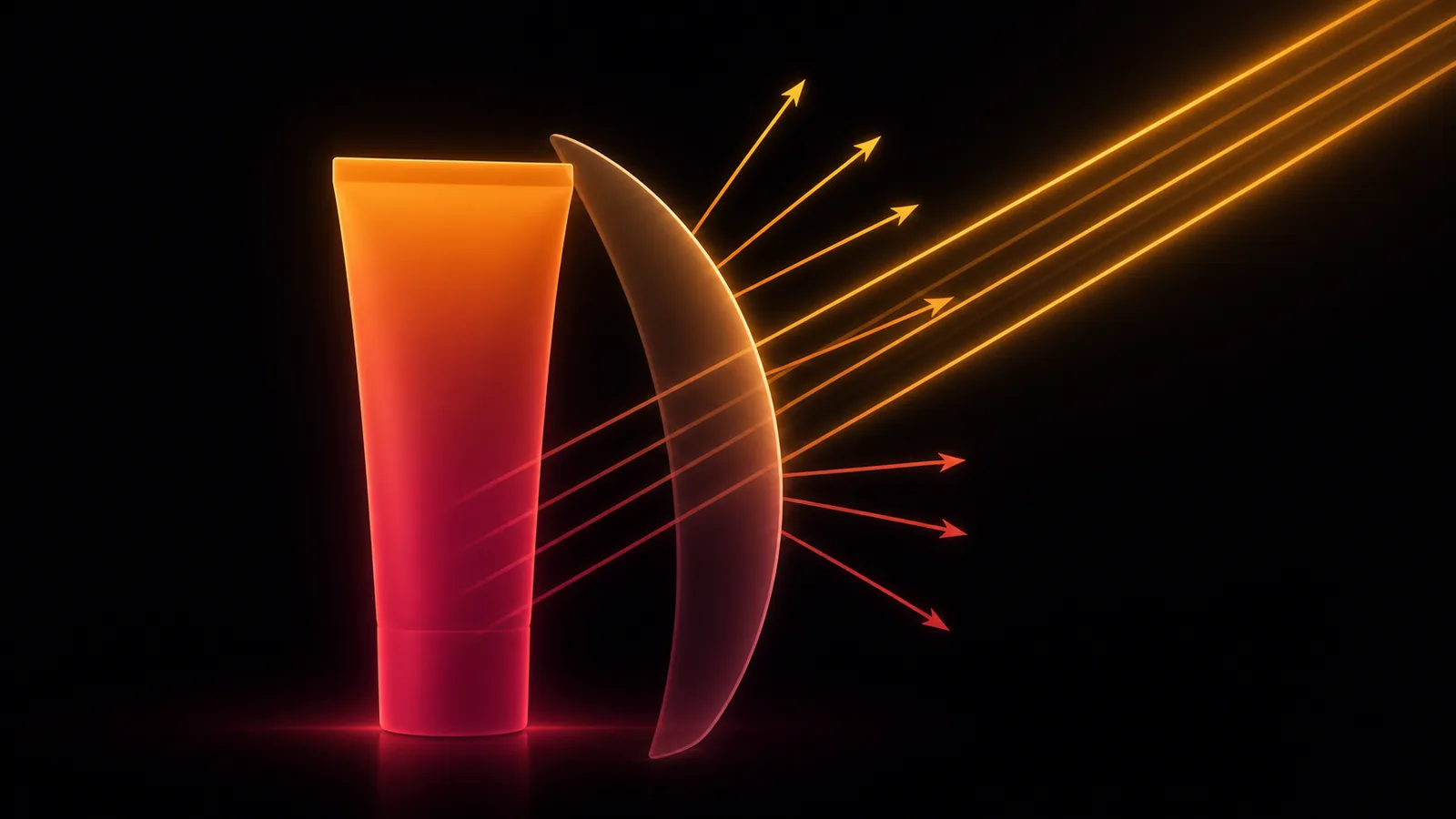
Yes. You will still tan with sunscreen on — it just takes longer, and that is the entire point. No sunscreen blocks 100 percent of ultraviolet, and the fraction that gets through is more than enough to trigger melanin production. What sunscreen removes is the part of the dose that burns you rather than colours you.
The follow-up question, "does SPF 50 prevent tanning?", has the same answer: it slows it down, and in real-world use it slows it down considerably less than the number suggests.
What SPF actually means
SPF is a ratio, not a percentage of protection. An SPF 30 means it took 30 times more UV to produce redness on protected skin than on unprotected skin, measured in a laboratory.
Converted to transmission:
| SPF | UVB blocked | UVB reaching skin |
|---|---|---|
| 15 | ~93% | ~1 in 15 |
| 30 | ~97% | ~1 in 30 |
| 50 | ~98% | ~1 in 50 |
Two things stand out. First, the jump from SPF 30 to SPF 50 adds roughly one percentage point of blocking — the label number changes far more than the protection does. Second, even at SPF 50 a real fraction of UV still reaches your skin, and over an afternoon that fraction is plenty to stimulate melanocytes.
The gap between the label and reality
SPF is tested at 2 milligrams of product per square centimetre of skin. That is a genuinely thick layer — roughly a shot glass, about 30 ml, for a whole adult body, and around half a teaspoon for the face and neck alone.
Application studies consistently find people apply between a quarter and a half of that. Protection does not scale linearly with thickness, so applying half the tested amount does not give you half the SPF — it gives you considerably less. An SPF 30 applied the way most people apply it commonly behaves closer to SPF 5–10.
Add the other real-world losses:
- Time. Chemical filters degrade under UV. Two hours is the standard reapplication interval for a reason.
- Water and sweat. "Water resistant" means the SPF held for 40 or 80 minutes of immersion in testing, not that it is waterproof.
- Towelling off. This removes a large share of what is left.
- Missed patches. Ears, the hairline, the tops of the feet, the backs of the knees and the strip along a swimsuit edge are the classic ones.
So the honest picture is that most people wearing SPF 50 are getting somewhere in the SPF 10–20 range for the first hour or two, and much less after that. Which is why they still tan — and why they still burn if they treat the bottle as a licence to stay out all day.
Tanning with sunscreen on: how it works out
You are not choosing between "tan" and "no tan". You are choosing the ratio of pigment gained to damage taken.
Without sunscreen, at a UV index of 8, fair skin reaches its burn threshold in under 20 minutes. Past that point the skin is injured, and injured skin peels — taking the new melanin with it. The tan you thought you were building sheds in a week.
With sunscreen, the same skin can be out for an hour or more. Melanin synthesis, which happens over hours and continues for days after exposure, gets more time to run without the exposure crossing into injury. In practice a controlled, protected session over several days produces a more even and longer-lasting tan than one unprotected session that ends in redness.
There is no version of this where sunscreen is the thing standing between you and a tan.
What about "tanning oils with SPF"?
Low-SPF tanning oils — typically SPF 4 to 15 — do what their number says and no more. An SPF 6 lets through roughly one sixth of incoming UV; at UV 8 that turns a 20-minute fair-skin limit into about two hours, which sounds generous until you notice most people using them stay out for four.
Oils without any SPF are worse than nothing meaningful: they improve UV transmission into the skin and offer no protection. Baby oil and olive oil belong in the same category.
Choosing sunscreen if you want to tan
- Broad spectrum. UVA drives photoageing and contributes to melanoma risk while producing mostly the temporary, non-protective kind of pigment darkening. In the EU, look for the circled UVA logo; elsewhere, look for "broad spectrum".
- SPF 30, applied properly, beats SPF 50 applied thinly. The application is the variable that matters.
- Use enough. Around 30 ml for a full body, half a teaspoon for face and neck.
- Apply 15–20 minutes before going out so chemical filters can settle.
- Reapply every two hours, and immediately after swimming or towelling.
- Mineral filters (zinc oxide, titanium dioxide) work immediately on application and are worth considering for sensitive or reactive skin.
The one thing sunscreen cannot do
It cannot extend your time indefinitely. Protection multiplies your baseline, and your baseline depends on your skin type and the current UV index. An SPF 30 that is behaving like an SPF 10 in practice turns a 20-minute limit into about 200 minutes — but only if you actually reapplied on schedule, and only at that UV level. Two hours later, at a higher index, on a patch you missed, the arithmetic is different.
Which is the case for tracking it rather than estimating. Sunlit takes the live UV index for your coordinates, your Fitzpatrick skin type and the SPF you actually applied, and turns them into a session timer with reapplication prompts at the right intervals. It is free on iPhone and iPad, and it does not need an account.
Related reading
- How to Tan Without Burning: A Step-by-Step Method
- What UV Index Is Good for Tanning? The Honest Answer
- How Long Does a Sunburn Last? The Hour-by-Hour Timeline
General information about sun protection, not medical advice. Sunscreen reduces but does not eliminate the risks of ultraviolet exposure, and no exposure level is entirely risk-free. If you have a history of skin cancer or take photosensitising medication, follow your doctor's guidance. Sources: published studies on real-world sunscreen application thickness (Petersen & Wulf and others); ISO 24444 SPF test methodology; American Academy of Dermatology and EU Commission Recommendation 2006/647/EC on sunscreen labelling.