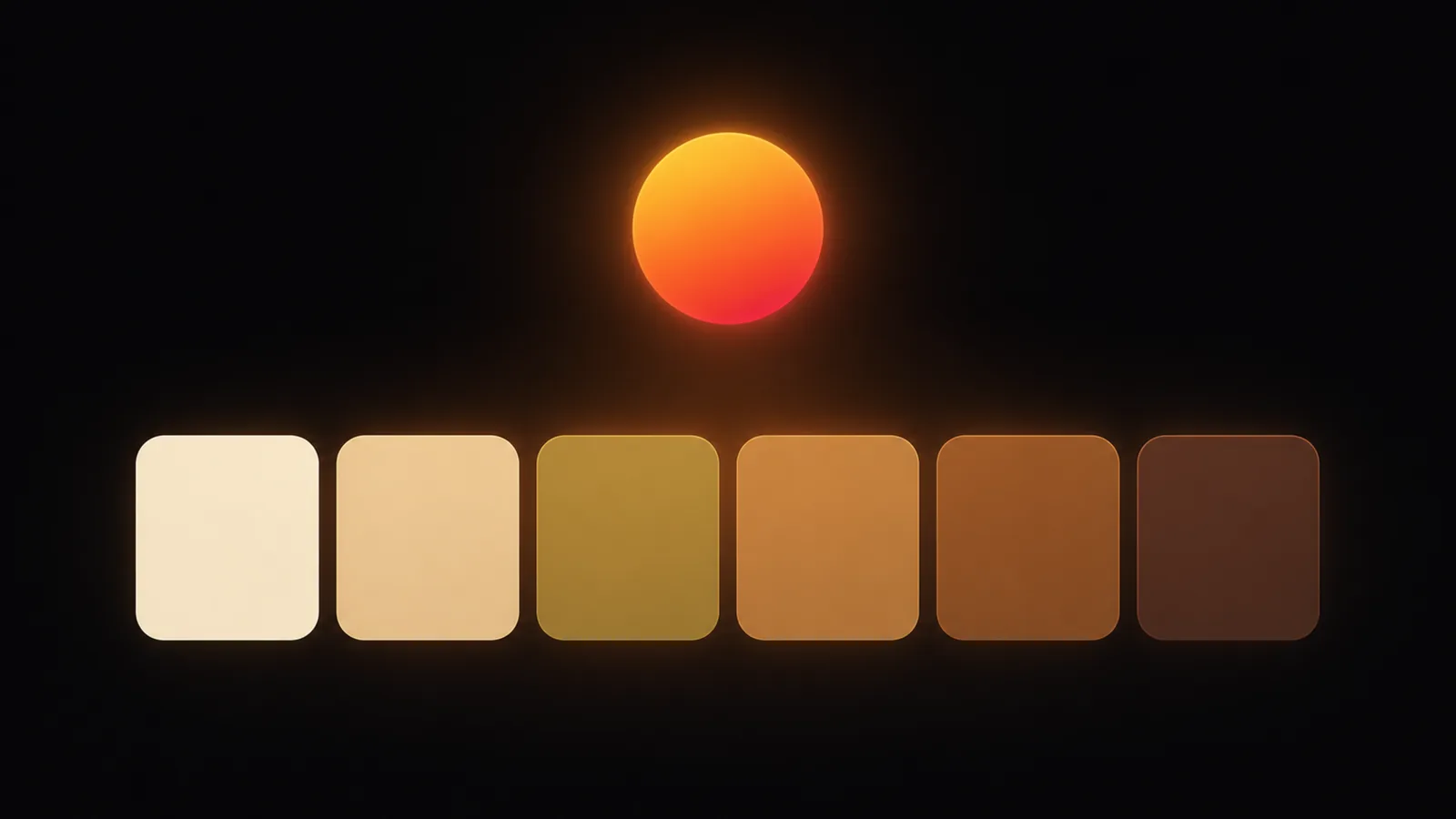
The Fitzpatrick scale sorts skin into six types based on one thing: how it reacts to ultraviolet light the first time it is exposed after a period without sun. It is not a colour chart and it is not an ethnicity classification. Type I burns and never tans; type VI is deeply pigmented and essentially never burns. Everything useful about it comes from that reaction, not from appearance.
This page explains the six types, how to work out your own, and where the scale is genuinely useful versus where it is routinely over-applied.
Where the scale came from
Thomas Fitzpatrick, a dermatologist at Harvard, published the classification in 1975 and refined it in 1988. It was created for a specific practical problem: doctors giving phototherapy needed to know how much UV a patient could tolerate as a starting dose. Guessing from skin colour produced burns, so Fitzpatrick built the scale around the patient's own reported history of burning and tanning.
That origin matters. The scale predicts UV sensitivity, which is exactly what it was designed for, and it does that job well. It was never designed to describe race, and using it that way produces poor results at both ends.
The six types
| Type | Reaction to first strong sun | Typical features |
|---|---|---|
| I | Always burns, never tans | Very pale, often freckled; red or light blond hair; blue, green or grey eyes |
| II | Burns easily, tans minimally | Fair; blond to light brown hair; blue, green or hazel eyes |
| III | Burns moderately, tans gradually | Fair to light olive; dark blond to brown hair; hazel or brown eyes |
| IV | Burns rarely, tans easily | Olive or light brown; dark brown hair; brown eyes |
| V | Very rarely burns, tans darkly | Brown; dark brown to black hair |
| VI | Never burns, deeply pigmented | Deeply pigmented dark brown to black |
The physical features in the right-hand column are correlations, not the definition. Plenty of people have brown hair and brown eyes and still burn like a type II. When appearance and burn history disagree, the burn history is correct.
How to work out your type
Answer for your skin after a winter or several months with no meaningful sun exposure, not for how you look right now. Judging from an existing tan is the most common way people place themselves one or two types too high.
Two questions do most of the work:
1. Spend 30 minutes in strong midday summer sun with no sunscreen. What happens?
- Painful redness, always → type I
- Redness, usually → type II
- Mild redness sometimes → type III
- Rarely any redness → type IV
- Essentially never → types V–VI
2. What does your skin look like a week later?
- Peeling, no colour gained → type I
- Slight colour → type II
- A light, even tan → type III
- A good tan → type IV
- Deepens noticeably → type V
- Already deeply pigmented → type VI
If the two answers point to adjacent types, take the lower one. Erring low costs you a few minutes of sun; erring high costs you a burn.
What your type actually tells you
Your Fitzpatrick type predicts your minimal erythemal dose (MED) — the UV energy needed to produce just-visible redness. Approximate erythemally weighted ranges:
| Type | Approx. MED (J/m²) | Unprotected time to redness at UV 8 |
|---|---|---|
| I | 150–200 | ~13–17 min |
| II | 200–250 | ~17–21 min |
| III | 250–350 | ~21–29 min |
| IV | 350–450 | ~29–38 min |
| V | 450–600 | ~38–50 min |
| VI | 600–1000 | ~50–83 min |
The five-fold spread from type I to type VI is the entire reason generic advice like "don't stay out more than 20 minutes" is useless. It is either dangerous or absurdly conservative depending on who reads it.
Because the UV index is linear, you can scale any of these: halve the index, double the time.
Where the scale runs out
It compresses deeply pigmented skin. Types V and VI cover an enormous range of real skin tones and UV responses. Researchers increasingly pair Fitzpatrick with an objective measure — individual typology angle (ITA°) from a colorimeter — precisely because self-reported burn history is least reliable at this end.
Self-reporting is imperfect. People recall their burn history inaccurately, and cultural framing shifts answers. Validation studies find only moderate agreement between self-assigned type and measured MED.
It ignores several important modifiers. Photosensitising medication (some antibiotics, diuretics, retinoids, NSAIDs), conditions such as lupus or vitiligo, pregnancy, and recent chemical exfoliation or laser treatment all raise UV sensitivity independently of type. So does recent exposure history — skin that has seen sun over the past fortnight tolerates more than skin that has not.
A low burn risk is not zero cancer risk. Types V and VI burn rarely, but skin cancer in deeply pigmented skin is more often diagnosed late and at a worse stage, frequently in less sun-exposed sites such as the soles and nail beds. "I never burn" is not the same as "I never need to check my skin".
Using your type day to day
Once you know your type, the practical routine is:
- Check the live UV index — not the temperature, and not how bright it looks.
- Look up your unprotected limit at that index from the table above.
- Plan for half of it if you are trying to tan, or apply and reapply sunscreen if you are simply going to be outside.
- Adjust downward if you are at altitude, near snow, water or sand, or taking anything photosensitising.
- Re-evaluate after 24 hours, because erythema peaks well after the exposure ends.
That loop — type plus live UV plus a timer — is what Sunlit automates. It works out your Fitzpatrick type from a short questionnaire (or estimates it from a photo, with the result always editable), pulls the current UV index for your coordinates, and turns the pair into a timed session rather than a number you have to interpret. Free on iPhone and iPad, no account needed.
Related reading
- What UV Index Is Good for Tanning? The Honest Answer
- How to Tan Without Burning: A Step-by-Step Method
- How Much Sun Do You Need for Vitamin D?
General information, not medical advice. The Fitzpatrick scale is a population-level estimate of UV sensitivity; your own threshold may differ, and a self-assigned type is not a substitute for a dermatologist's assessment. If you take photosensitising medication, have a history of skin cancer, or notice a changing mole, seek clinical advice. Sources: Fitzpatrick, "The validity and practicality of sun-reactive skin types I through VI", Arch Dermatol 1988; WHO/WMO/UNEP/ICNIRP UV Index guidance; published MED ranges per skin phototype.