The UV index is a single number, usually between 0 and 12, that tells you how fast the sun is currently able to damage your skin. It is not a temperature, not a percentage and not a forecast of how sunny it looks outside. It is a measurement of ultraviolet intensity, weighted by how efficiently that ultraviolet burns human skin.
This page explains what the scale means, what each band actually implies for the time you can spend outside, and the details most weather apps leave out.
What the number measures
The UV index was standardised by the World Health Organization together with the World Meteorological Organization, the UN Environment Programme and ICNIRP, so that a "6" means the same thing in Sydney, Oslo and Nairobi.
Behind the number is the erythemal action spectrum — a curve describing how strongly each ultraviolet wavelength reddens skin. UVB around 297 nm burns roughly a thousand times more efficiently per unit of energy than UVA at 340 nm, so the raw amount of ultraviolet arriving is far less useful than the amount weighted by burning power. The index takes that weighted irradiance and divides it into units of 25 milliwatts per square metre.
That gives the scale two properties worth remembering:
- It is linear. UV 10 burns skin twice as fast as UV 5, and five times as fast as UV 2. Half the number, double the time.
- It is open-ended at the top. The scale is usually drawn to 11+, but tropical highlands genuinely reach 15 and above. There is no cap at 11; that is just where the published advice stops changing.
The UV index scale, band by band
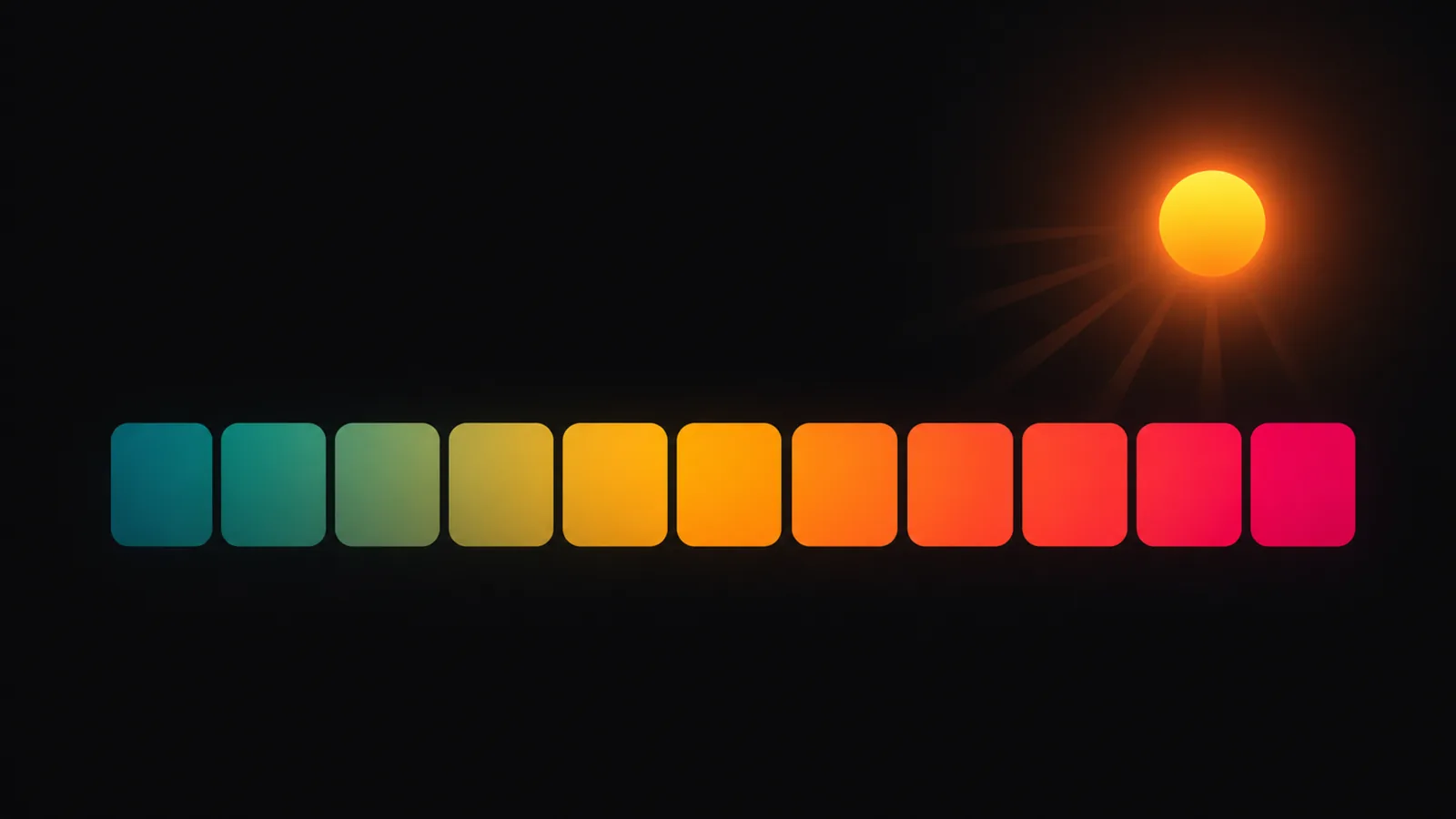
| Index | Band | What it means in practice |
|---|---|---|
| 0–2 | Low | Safe for most people. Fair skin can still burn over a long, unbroken afternoon, but no routine precautions are needed. |
| 3–5 | Moderate | The WHO protection threshold begins here. Seek shade near midday; fair skin reddens in roughly 25–50 minutes unprotected. |
| 6–7 | High | Protection required. Unprotected fair skin approaches its burn threshold in 15–25 minutes. |
| 8–10 | Very high | Skin damages quickly. Fair skin can burn in 10–15 minutes; midday sun should be avoided rather than managed. |
| 11+ | Extreme | Unprotected skin can burn in under 10 minutes. Treat midday outdoor time as something to schedule around. |
The band names are a communication tool. The underlying quantity is continuous — the difference between UV 5 and UV 6 is real, even though one is labelled "moderate" and the other "high".
What changes the UV index where you are
Sun elevation. This is the dominant factor by a wide margin. When the sun is low, its light passes through far more atmosphere, and the ozone layer removes most of the burning wavelengths along the way. This is why UV peaks within an hour or so of solar noon and collapses in the late afternoon, while temperature keeps climbing.
Season and latitude. Both are really the same effect: how high the sun climbs at noon. A June noon in Berlin and a December noon in Sydney differ by more in UV terms than most people expect.
Altitude. UV rises roughly 10 percent for every 1,000 metres of elevation. Mountain sun is not a myth.
Cloud. Thin or broken cloud reduces UV far less than it reduces glare and heat — and scattered cumulus can briefly raise it above the clear-sky value by reflecting extra ultraviolet toward you. This is the single most common way people misjudge a day. Heavy overcast does genuinely cut UV substantially, but "it's cloudy" is not a protection strategy.
Reflection. Fresh snow reflects up to about 80 percent of incident UV, effectively doubling your dose. Dry sand reflects roughly 15 percent, sea foam and water surfaces around 10–25 percent depending on angle. Sitting under a beach umbrella cuts direct sun but not the ultraviolet bouncing off the sand around you.
Ozone. Day-to-day fluctuations in the overhead ozone column move the index by several percent in either direction, which is why forecast and measured values do not always match.
Two things that do not change it: air temperature and how bright the day appears to your eyes. Visible light and infrared heat are not what burns you.
Reading a UV index chart correctly
A UV chart plots the index against the hours of the day, and it almost always forms a bell curve centred on solar noon — the moment the sun is highest, which is rarely 12:00 on your clock. Daylight saving time, your position within your time zone and the time of year can push solar noon well past 13:00.
Three habits make a chart genuinely useful:
- Read the curve, not the daily maximum. "Today's UV: 9" describes a single instant. If your plan is a 07:30 run, the number that matters is the one at 07:30 — probably a 2.
- Find the shoulders. The two points where the curve crosses UV 3 bracket the part of the day that needs protection. Everything outside them is comparatively cheap exposure.
- Check the hourly forecast, not yesterday's peak. Cloud and ozone move day to day.
Common misreadings
"The UV index is a percentage." It is not. There is no maximum of 100 percent; the scale is an intensity measurement with no defined ceiling.
"It's cold, so UV must be low." Altitude and snow both raise UV while lowering temperature. Ski burns are the classic result.
"I'm in the shade, so I'm at zero." Shade blocks the direct beam. Diffuse skylight and reflected UV from sand, water, concrete and snow can still deliver a substantial fraction of the open-sky dose.
"Behind glass I'm safe." Ordinary window glass blocks nearly all UVB but transmits a large share of UVA. You will not sunburn easily through a window; you will still accumulate UVA exposure on long drives.
"UV 3 is harmless." UV 3 is where the WHO advises starting protection, not where risk begins.
Turning the index into a personal number
The index tells you how fast the sun burns skin. It does not tell you how fast it burns your skin — that depends on your Fitzpatrick type, and the difference between the extremes is roughly five-fold. The same UV 7 afternoon is 15 minutes for one person and well over an hour for another.
The arithmetic is straightforward: your minimal erythemal dose divided by the index-derived irradiance gives your unprotected time to visible redness. Doing it in your head on a beach towel is less straightforward, which is why we built Sunlit — it pulls the live UV index for your exact coordinates from Open-Meteo, applies your skin type and SPF, and gives you a timed session and a 10-day forecast instead of a raw number you still have to interpret. Free on iPhone and iPad, no account required.
Related reading
- Can You Burn on a Cloudy Day? What Cloud Really Does to UV
- What UV Index Is Good for Tanning? The Honest Answer
- The Best Time of Day to Tan (It Is Not Noon)
General information about ultraviolet exposure, not medical advice. Individual sensitivity to UV varies with medication, medical conditions and recent exposure history. Sources: WHO/WMO/UNEP/ICNIRP, "Global Solar UV Index: A Practical Guide"; CIE erythemal action spectrum (ISO 17166 / CIE S 007); WMO guidance on UV forecasting.